

Determining the optimal time to send a press release is essential for maximizing its impact and grabbing the attention of journalists. Timing plays a crucial role in the success of your pitch, as you want to ensure that your press release stands out amidst the flood of emails in a journalist’s inbox.
So you’ve followed our press release writing guide to a tee, found media contacts to pitch your story to, and now you’re all set to hit send. Before you click that send button, look at your watch. Make sure you’re not sending your press release at a time when it’ll drown in a flood of emails.
Before reviewing the best time to send a press release, let’s talk about when not to send your press release.
Why you shouldn’t send your press release on a Monday
You might think it’s a great idea to send your press release first thing on a Monday morning, before other brands get the jump on you and get their press releases in there. On the contrary, Monday is one of the worst days to send your press release. Here’s why.
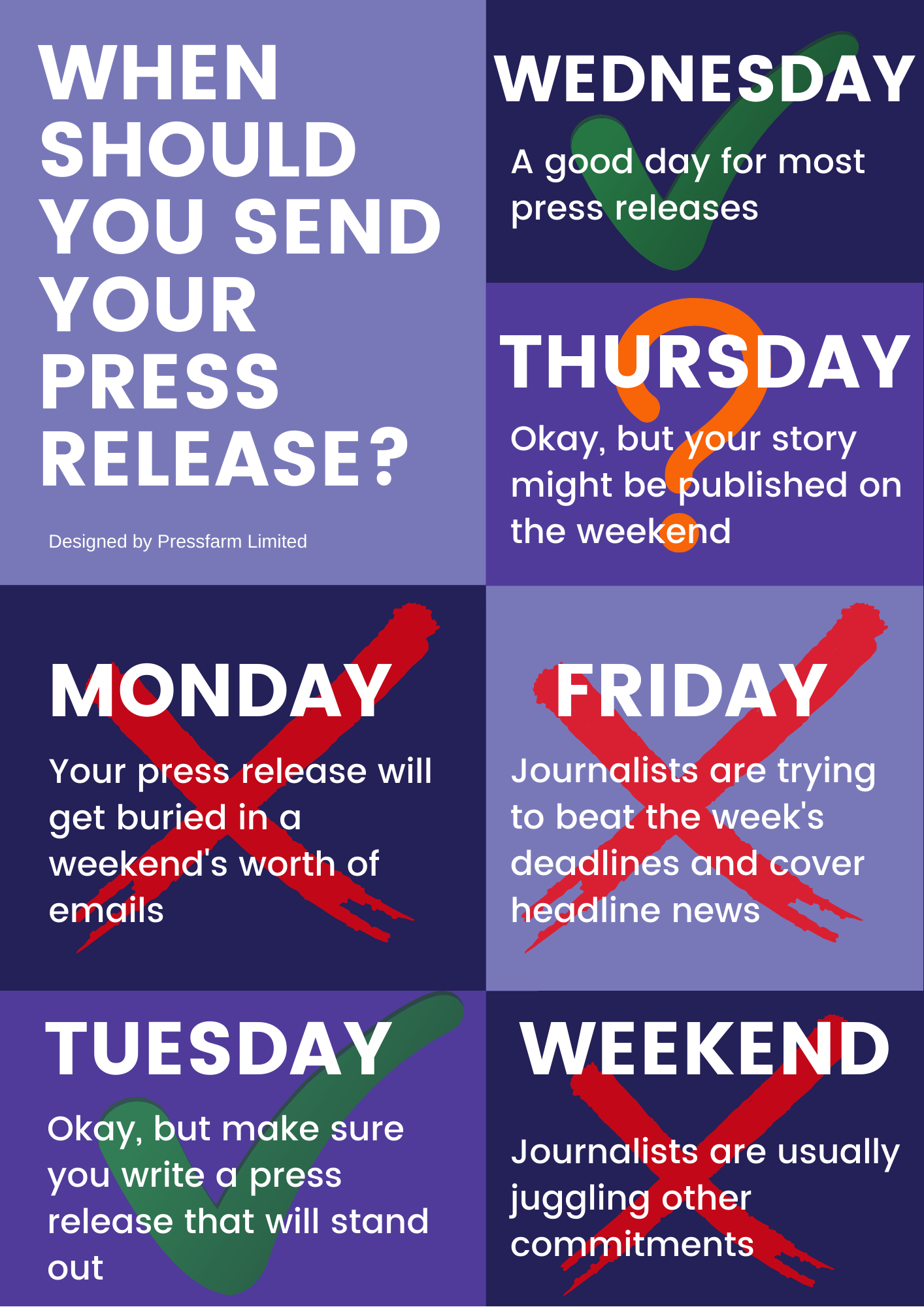
Given that Monday is the first day of the week, it’s also the busiest day of the week for most people. This is no different for journalists, who start their week struggling to catch up with a whole weekend’s worth of emails. On a Monday, they’re typically also trying to get ahead of news stories based on events from the weekend.
For these reasons, it’s important to steer clear of Mondays when you’re scheduling your cold email pitch.
Why you shouldn’t send your press release on a Friday
If Monday morning is a bad time to send a press release, is it better to get ahead of the Monday morning flood of emails by sending yours on Friday? No, please don’t do this.
Friday is a bad day to send your press release because journalists are usually racing to meet end-of-the-week deadlines. On Friday, your story is unlikely to be prioritized unless it’s headline news. And that is if the journalist you’re pitching to has had time to check their emails.
Why you absolutely shouldn’t send your press release over the weekend
The traditional structure of the workweek has changed. With many journalists working remotely, the difference between the work week and the weekend is getting less distinct. Be that as it may, most journalists still have competing priorities over the weekend. This is especially the case for journalists who have families.
It is therefore not a great idea to send your pitch during the weekend either. Emailing a journalist on the weekend will only result in your pitch joining the pile of emails they catch up with on Monday. This dramatically reduces the chances of your story being read.
Okay, so what is the best time to send a press release during the week?
Unfortunately, the answer to this question isn’t simple because no one time will work in all cases. To answer this question properly, let’s go through each of the three days left:
-
Tuesday
Tuesdays can be a good day to send your press release to journalists. Ideally, by Tuesday, journalists have caught up on the pile of emails that had accumulated over the weekend. However, you are likely to be competing with all the other brands who know this. For this reason, you will need to make an extra effort to ensure your press release stands out.
-
Wednesday
Wednesday is a good day because it’s not as busy as Tuesday. Nevertheless, this doesn’t mean you can get away with doing the bare minimum on Wednesday. You still need to perfect your press release to make sure that the journalist you are pitching spots it in their inbox, opens it, and reads it to the end.
-
Thursday
Alternatively, if you don’t send your press release on Wednesday, you can send it on Thursday. Nonetheless, the lead time for working on a story can sometimes be a few days. This means that your story might be published over the weekend. Is this a bad thing? Not always.
This means you should be clear about whether you are pitching to consumer media or trade media.
If you are pitching your story to consumer media, then it doesn’t matter if it’s published over the weekend. Your target audience might have more time to read your story over the weekend. If you are pitching to trade media, however, your target audience is likely to be paying less attention to these publications over the weekend.
What about the best time of day to send a press release?
The recommended time to send a press release is between 8 am and 9 am, 2 pm and 3 pm, or at 8 pm Eastern Standard Time. Having said this, your press release will stand a higher chance of being read before 5 pm when offices close.
With these time slots in mind, you should also avoid sending a press release exactly on the hour, since many brands target the hour. For example, instead of sending your press release at 9 am, try 8:45, 9:05, or 9:15. Doing this will help you avoid the peak times for press releases. With this strategy, your press release will have a better chance of standing out.
Why time zones are important
You might be emailing a journalist in Europe at 2 pm your time, without realizing that it’s dinnertime in Europe. This is bad news if you’re hoping the journalist will read your email before morning.
To avoid making a mistake like this, it is essential to double-check the timezone of your media contacts before you send your press release. If they are based outside the U.S., ensure you are sending your email during the same recommended hours in their local time.
Pay attention to specific seasons
One thing that’s easily forgotten while doing media outreach is the effect special seasons and industry events can have on your success rate.
It is common knowledge that pitching during a public holiday isn’t a good idea. You should avoid sending a press release the week of Christmas unless you have timely news related to the holiday. Similarly, the journalist you’re pitching to is unlikely to have their nose buried in their emails on New Year’s Day.
Did you know that industry events can also affect the success of your press release pitch? For example, you shouldn’t pitch a tech journalist during Black Hat. The journalist will probably be networking and wandering around exhibition halls instead of sitting in front of a computer looking through their emails.
If you’re pitching the tech journalist above because your brand will be involved in Black Hat, that’s another story. You should send your pitch at least one month before the event. This gives the journalist ample time to share your news and build publicity for you before the actual event.
Pay attention to past engagement with a journalist
Is the journalist you’re about to email the same journalist you successfully pitched just last week? If this journalist has just written a story about your brand, it’s unwise to ask them to write yet another story so soon after the last one. While you want to be seen as a reliable source of information, bombarding the same journalist with one press release after another is not a good idea.
Likewise, if you’ve pitched a journalist before and they replied to reject your pitch, then you should ask them how to tailor your pitches better for them in the future. Getting that information beforehand will help you later with the next pitch to them.
Pay attention to the organization’s practices
Just as it’s helpful to know how a journalist likes to be pitched, it’s also important to understand the best practices of the media organization you are sending your press release.
What kind of pitches do they prefer? What is their lead time? Answering these questions will help you craft a good press release and send it at the perfect time.
Be consistent
Sending a press release isn’t a one-time thing. Consistency in the future is just as important as getting the timing right the first time. If you send your press release at the perfect time but the journalist doesn’t write a story about you, don’t give up.
Once the journalist realizes you are a reliable source of consistent and valuable information, they will start to see you as a trusted news source. In time, they will start picking up your press releases and publishing stories about you.
Always send your press release
Having said all this, don’t tuck your press release away and forget about it just because it’s not the perfect time.
Sometimes you have an urgent press release that is newsworthy and timely. Likewise, on some days, you don’t have time to send your press release later on. In this case, you should send it as soon as possible.
How to write a press release that will stand out at any time of day
As we just said, sometimes you just have to close your eyes, hit send, and hope for the best. Let’s talk about how to make sure your press release will stand out, regardless of what time you send it.
-
Use visuals
Using illustrations on your press release will make it easier and more enjoyable to read. Illustrations such as graphs, infographics, and pictures help readers understand any data and numbers in your press release.
-
Make sure your content is relevant and useful
For your content to be memorable, highlight the value your story has for your target audience. How does your news help society? Will the product or service you’re launching solve a common problem? Talk about this and your audience will read the press release attentively, from beginning to end.
-
Include a call to action
Instead of just assuming your audience will go to your website for more information, tell them where to go. Including a call to action is the best way to encourage long-term engagement from your audience.
If your open rate is low, you might want to tweak your strategy in the future. In addition to timing, you can incorporate the above elements to help your press release email stand out.
Over to you – when is the best time to send a press release?
At the end of the day, there is no hard and fast rule for the best time to send your press release. Depending on who you ask, the best day can range anywhere between Tuesday and Thursday. If you ask about the best time, you’ll get an even wider range of answers. As we said previously, there is no single answer to this question.
Having said that, there are things which you shouldn’t do:
- DON’T send your press release on a Monday
- DON’T send your press release on a Friday
- DON’T send your press release on a weekend
- DON’T send your press release exactly on the hour
And things which you should do:
- DO target off-peak hours
- DO provide journalists with valuable information
- DO make sure your press release will stand out no matter when you send it
But at the end of the day, your industry, your location, and your target audience could affect the best time to send press releases.
For this reason, you will need to rely on your best judgment to determine the best time to send your press release. Past data regarding the performance of your press release emails can also help you figure out which times work better for your brand.
Some media outreach tools can help you collect relevant data about the performance of these press release emails so that you can adjust your strategy accordingly. For example, you can find out the optimal time to send email pitches based on your data. You can also see which journalists have opened your email.
Do you need help writing a press release that will capture a journalist’s attention? Check out our packages and let us worry about writing your press release.
